By: Dr. Bentley Lorene Gibson
From 2021 to 2025, I had a front row seat to something rare. First I watched a bias mitigation program actually work. Then I watched what happens when it gets taken apart.
I partnered with a large organization, which I will keep anonymous, to build a bias mitigation program from the ground up. In the first two years, every employee took my implicit bias course. Every quarter, I led workshops on the biases actually showing up in that workplace: microaggressions against Black, Hispanic/Latino, and AANHPI employees, bias in hiring, bias in performance reviews.
It worked. Implicit Association Test results showed employees' unconscious biases around race, gender, and career measurably declined. People from every corner of the organization came together in those sessions and talked to each other, not just to me, about hard truths and honest questions. That kind of room is rare in most workplaces.
Then the attacks on DEI came.
I watched the pullback happen in slow motion. First my budget was cut. Then the quarterly workshops disappeared. Individual teams wanted to keep working with me, but couldn't, because every DEI initiative now had to be approved at the parent organization level. By 2024, employees had only my online course left. Then that was pulled too. No replacement plan. Nothing.
The numbers don't lie
I ran a Kruskal-Wallis analysis comparing 2022, the peak of the program, to 2025, after the cuts. The results were statistically significant at p < .001. Here is what changed:
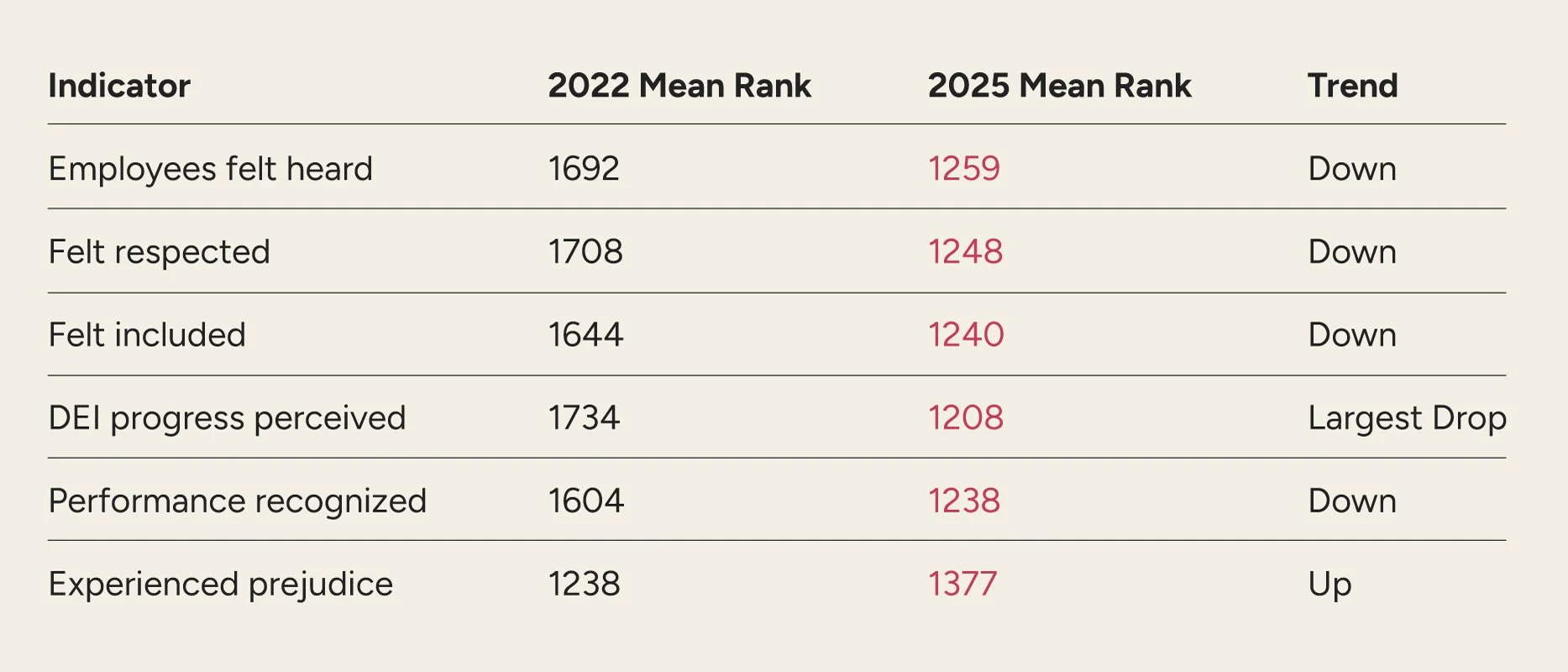
A quick note on how to read this. These are mean ranks from a Kruskal-Wallis test, not percentages, so a higher number means a better experience on every measure except the last one. For prejudice, a higher number is worse. Read across the table and the pattern is simple. Every measure of belonging and respect fell. The one measure that should have stayed low went up.
The most painful finding is that last row. Employees reported experiencing more prejudice in 2025, years after the program was gutted, than they had in 2022 at the height of it.
What this means for your organization
DEI work is not a box you check once and walk away from. A functioning program does not just shift unconscious bias scores. It gives people infrastructure: a place to connect, to be heard, to act on what they learn. Remove that infrastructure, and the culture does not simply plateau. It erodes, measurably, on a timeline you can track.
If your organization is weighing whether to cut bias mitigation work, this is what four years of data actually says you are deciding. Not whether to trim a budget line, but whether to remove the structure holding a piece of your culture together, and whether you are prepared to explain the resulting numbers to your board eighteen months from now.
See where your own organization stands.
The Bias Risk Scorecard, the same 8 point framework used to evaluate Target's $20B loss and Costco's 8.2% growth, takes five minutes and shows you exactly where the exposure is before it shows up in an engagement survey.
Sources:
Kruskal-Wallis test, internal client data (2022 to 2025), Dr. Bentley Gibson. Company identity withheld per client agreement.
About the author: Dr. Bentley Gibson, PhD, is a cognitive and developmental psychologist specializing in implicit bias, and the founder of The Bias Adjuster. Her published research includes studies on the early development of racial bias in children (Journal of Cognition and Culture).