When Shopping Is No Longer a Pleasure: How One Manager's Decisions Can Put Publix's Southern Hospitality at Risk
By: Dr. Bentley Lorene Gibson
Publix is known for its southern hospitality. I grew up in New York, and when I go home to visit my parents, I catch myself looking for it in every store I walk into. Someone offering to help me out to my car. A genuine smile at the register. Or even better, someone who knows my kids by name.
At my local Publix in Decatur, Georgia, that someone is Ms. Susanne.
“Southern hospitality is not a slogan. It is a decision every leader makes, one customer at a time.”
Fifteen years of Ms. Susanne
Ms. Susanne has worked at my Publix since I was in my early to mid twenties, before I ever became a mother. She saw me through my pregnancy with my daughter. She celebrated her birth. And she has watched that little girl grow into a teenager.
The two of them share a beautiful bond, and they also share the same birthday. When they see each other, they hug like family. I have watched other shoppers pick up on that energy and smile. Their joy brightens the whole front end of the store. That is what a hometown grocery store brand is built on. Not the logo. The people.
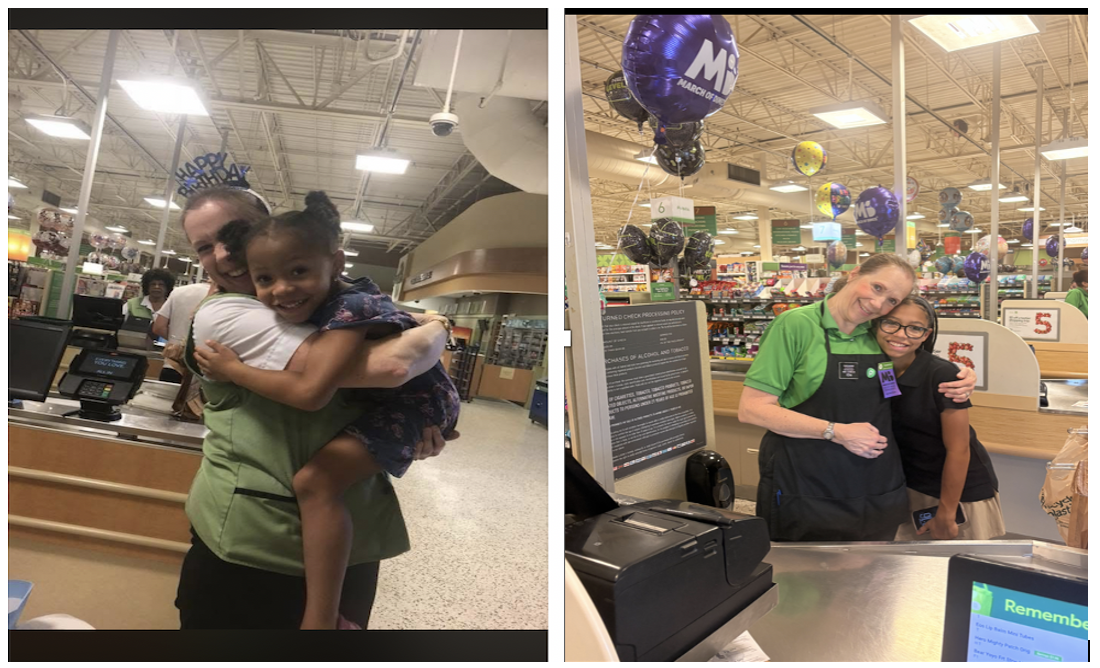
Ms. Susanne and my daughter, around age 5, on their shared birthday. Same register, same hug, eight years later.
The morning it changed
Last holiday season, I ran in during the early morning rush, between getting dressed and getting my kids to school, to grab gift cards for their teachers. I handed over ten gift cards at the register and asked for $20 on each.
The bagger would not hand me the cards. She said she could not release them until they were paid for. Fair enough. I swiped my card and paid for my groceries and all ten gift cards. The receipt printed. I asked for my cards.
Instead, she walked away and came back with the manager.
Now I was embarrassed, frustrated, and about to be late. The manager was holding gift cards I had already paid for. Rather than look at the receipt and hand them over, he went back and forth with me. Finally I said, firmly, "Sir, I have paid for the cards in your hand, and you need to give them to me." He handed them over. I walked out with my heart pounding.
I understand policy. Gift card fraud is real, and stores have every reason to be careful. But I had already paid. The transaction was complete. What happened next was not policy. It was a judgment about who I might be.
After I dropped my kids off, I went back. I wanted to understand why it happened, and I wanted to give the manager a chance to apologize. He refused, and he doubled down.
Why I came back anyway
I almost never returned. Then I remembered that this is the Publix closest to my home. My kids and I know these aisles like the backs of our hands. And people like Ms. Susanne are there every week, giving love to the customers who walk through those doors.
I refuse to let one manager take that from us. But I know other customers will not make the same choice.
When I shared my story with a few employees I am close to, they did not let me finish. They already had their own stories about this manager, and about how his biases had affected them. That told me something every leader should hear: a manager who profiles customers is rarely only profiling customers.
What the research says
My experience is personal, but it is not unusual. The data on bias at the register and in the break room is consistent.
Customers notice, and many do not come back. In a national survey of more than 1,000 Black shoppers, about 90% reported being racially profiled while shopping, and slightly more than half of those who experienced profiling or microaggressions never returned to that store (DealAid, 2021).
Being treated as a suspect is common. In a Case Western Reserve University study of middle-class Black shoppers, 59% reported being perceived as a shoplifter, and participants described this treatment in grocery stores as well as department stores (Pittman, 2017).
It shows up in stores more than almost anywhere else. A 2018 Gallup study found that more Black shoppers reported unfair treatment in a store within a 30-day period than at work, with police, or at a restaurant or entertainment venue (Sephora, 2021).
Employees feel it too. Sephora's Racial Bias in Retail Study found that two in five U.S. shoppers had personally experienced unfair treatment based on race or skin tone, and about one in three retail employees had considered quitting after experiencing racial bias, rising to 37% among Black employees (Sephora, 2021).
Managers set the culture. SHRM found that 76% of employees say their manager sets the workplace culture, and 58% of people who left a job over culture named their manager as the reason. Culture-driven turnover cost U.S. employers an estimated $223 billion over five years (SHRM, 2019).
One manager changes the whole team. Gallup estimates that managers account for at least 70% of the variance in employee engagement across business units (Gallup, 2015).
A policy protects a store. A bias, left unchecked, costs it the customers and employees who trusted it most.
I am not the only one
In 2020, Tawanda Crowell, a Black mother in Jacksonville, Florida, was accused of shoplifting after a Publix employee reported not seeing her receipt. Outside the store, an off-duty sheriff's officer confronted her, and she was tased and arrested in front of her goddaughter and nieces. The charges were dropped, but she lost her job because of the arrest. She sued Publix, and civil rights attorney Ben Crump joined her case, calling on the company to apologize. Publix responded in court that the officer was not its employee and that it did not ask him to make an arrest (Action News Jax, 2021; Loss Prevention Media, 2021).
Her story ended very differently from mine. But both started the same way: someone decided a paying customer might be a thief.
And we have seen how this plays out for brands. In 2018, a Starbucks manager in Philadelphia called police on two Black men waiting for a friend. The arrest was filmed on a phone, and it triggered protests and boycott threats. The manager left the store, and Starbucks closed more than 8,000 U.S. stores for an afternoon to put roughly 175,000 employees through racial bias training (CBS News, 2018; NBC News, 2018). Today, many customers have their phones ready. One manager's assumption can become a company's headline.
What Publix can do
I hope Publix continues to make sure its leaders are inclusive, and that it does so with strategies that last, not one-off trainings.
Training cannot be one size fits all. A bagger, a cashier, a store manager, and a corporate leader face different moments of decision. A bagger needs clarity on what policy actually requires. A manager needs to recognize when a policy has already been satisfied and a judgment is creeping in. Corporate needs systems that track patterns, not just individual complaints.
Training must include everyone. Publix is known for creating jobs for people with disabilities and the neurodivergent community. That commitment should extend to professional development that is designed for how each person learns and works, not a single module everyone clicks through.
Accountability must include repair. The fastest way to keep a 15-year customer is a sincere apology. The fastest way to lose one is to double down.
Ms. Susanne did not learn my daughter's name from a training module. She learned it because she chose, every single visit, to see us as people. That choice is the brand. When a leader makes the opposite choice, it puts the southern hospitality, hometown grocery store reputation at risk.
Hospitality is the culture your best employees build. Bias is the culture your leaders allow.
At The Bias Adjuster, we help organizations close that gap. Through IAT-based assessments, organizational equity audits, and role-specific training for everyone from frontline associates to managers to corporate leaders, we help leaders recognize their blind spots, make fairer decisions in the moments that matter, and build a culture where every customer and employee is treated like they belong.

.Sources
BeautyMatter. (2021, January 18). Just the facts: Racial bias in retail. https://beautymatter.com/2021/01/just-the-facts-racial-bias-in-retail
Beck, R., & Harter, J. (2015, April 21). Managers account for 70% of variance in employee engagement. Gallup Business Journal. https://news.gallup.com/businessjournal/182792/managers-account-variance-employee-engagement.aspx
Case Western Reserve University. (2017, November 16). Racial profiling by retailers creates an unwelcome climate for black shoppers, study shows. https://case.edu/news/racial-profiling-retailers-creates-unwelcome-climate-black-shoppers-study-shows
CBS News. (2018, May 29). Starbucks closes over 8,000 stores for anti-bias training. https://www.cbsnews.com/philadelphia/news/starbucks-to-close-over-8000-stores-for-anti-bias-training
Inclán, L. (2021, April 1). High-profile civil rights attorney, Ben Crump, joins Jacksonville mom’s case against Publix. Action News Jax. https://www.actionnewsjax.com/news/high-profile-civil-rights-attorney-ben-crump-joins-jacksonville-moms-case-against-publix/72PQNJK2ORH5VCHL75SN2DYYQQ
Loss Prevention Magazine. (2021, April 2). Woman wrongly accused of stealing from retailer stunned; arrested. https://losspreventionmedia.com/bodycam-woman-wrongly-accused-of-stealing-from-retailer-stunned-arrested/
NBC News. (2018, April 17). Starbucks will temporarily close 8,000 U.S. stores for racial-bias education. https://www.nbcnews.com/news/us-news/starbucks-will-temporarily-close-8-000-u-s-stores-racial-n866746
Petchenik, M. (2021, June 7). Study: Majority of Black shoppers have been racially profiled. WSB-TV. https://www.wsbtv.com/news/local/study-majority-black-shoppers-have-been-racially-profiled/CUHD6T6X4ZGPXEWUQ62XSRZ3LM
Society for Human Resource Management. (2019). SHRM reports toxic workplace cultures cost billions [Press release]. https://www.shrm.org/about/press-room/shrm-reports-toxic-workplace-cultures-cost-billions
About the author: Dr. Bentley Gibson, PhD, is a cognitive and developmental psychologist specializing in implicit bias, and the founder of The Bias Adjuster. Her published research includes studies on the early development of racial bias in children (Journal of Cognition and Culture).